

Recently I’ve been re-reading All About Love (2000) by bell hooks. I’m on the last chapter now. Take a shot every time I mention bell hooks on my website.
I was meant to finish it yesterday, but my sister reached for our monthly video call. As always, the conversation drifted. At some point, we landed on interracial dating, and more specifically, why neither of us could see ourselves easily dating outside of our race. Not because of a lack of openness, but because of the emotional labour that often comes with it, the need to explain your lived reality, and the even harder task of asking someone to not just understand, but to reconsider their own framework in order to empathise with something that doesn’t belong to them.
We talked until 1 a.m. I didn’t go back to the book.
This morning, I went to watch The Drama (2026). I wasn’t particularly drawn to it, despite liking Zendaya as an actor. But a friend told me she watched it and didn’t understand what it was trying to say. That was enough to convince me. I booked a ticket for Saturday morning.
I’m writing this minutes after it ended.
And the only thing I can think about is love.
SPOILERS AHEAD:
Love is not an emotion:
Some films have a plot. Others make the characters the plot.
The Drama belongs firmly to the second category. It is less concerned with what happens, and more with how people move through what happens. The title says it plainly: the film is about emotional process. But what it is really about is this:
love is not an emotion. It is an action.
bell hooks defines love as “the will to extend one’s self for the purpose of nurturing one’s own or another’s spiritual growth.” (hooks, 2000) Not a feeling. A practice.
And this is where the film becomes interesting:
Restarting as a form of love:
The central relationship in the film attempts to restart itself three times:
- at the coffee shop
- after intimacy fails
- and in the final scene
Each time, she initiates the restart. But not all restarts are equal. The first and the last have something in common: she is trying to repair his mistake, and he accepts the restart. He allows it. The second time, when she is the one at fault, he refuses.
That asymmetry becomes the emotional core of the film.
From the beginning, he struggles to meet her where she is. He wants the relationship to look right, to fit a narrative, to be legible to others. But he does not know how to love her in her full complexity.
hooks (2000) writes that love cannot exist without recognition and acceptance. To love someone is to see them as they are, not as an extension of your own image.
And he fails at that. Repeatedly. Until the final scene.
The fast food restaurant:
Early in the film, he refuses the idea of going to a fast food restaurant after their wedding as it didn’t “feel right”. It’s a small moment, but it says everything. He resists entering her world.
In the final scene, he ends up there all alone. Until she joins in, a surprise to him.
This time, he stays.
It’s subtle, but it’s the clearest moment of growth in the film. Not a grand gesture, not a speech, just a quiet willingness to step into her reality without trying to reshape it.
To love someone is not to fix them. It is to meet them.
Conditional love and social performance
Around them, the film builds a world of conditional relationships.
His friends are his friends, not hers. They share similar backgrounds, similar values, similar blind spots. When she opens up about something she regrets, they judge her, not because of the act itself, but because it disrupts the image they want to maintain.
Love, in this context, becomes conditional:
- conditional to respectability
- conditional to perception
- conditional to narrative
hooks (2000) warns against this directly. She describes how many people confuse love with control, or with the desire to maintain a certain image of self and others. But love requires honesty, and honesty often disrupts image.
What the film shows us is a group of people more invested in being seen as good than in actually being good to each other.
Friendship, hypocrisy, and quiet violence:
The maid of honour is one of the most interesting characters in this regard. She is not written as a villain, but as something more uncomfortable: human.
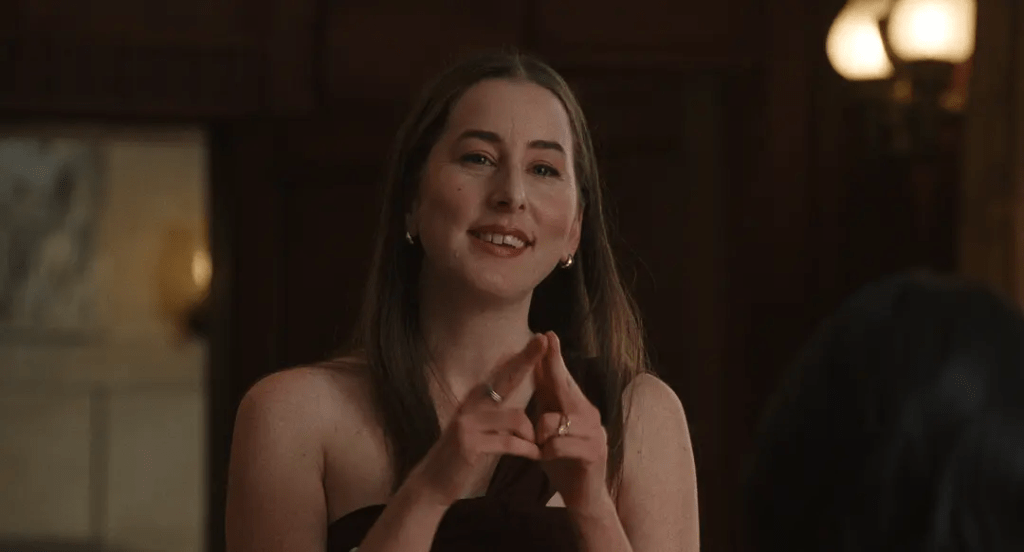
She presents herself as a friend, but her actions reveal something else. When her friend no longer fits the version of her she prefers, she withdraws, judges, and ultimately contributes to the unraveling of the wedding. At one point, she expresses surprise at being chosen as maid of honour, asking, “doesn’t she have other friends?”
That line exposes everything.
There was no real intimacy there. No real recognition. The relationship was sustained by proximity, not by care.
hooks (2000) insists that love and domination cannot coexist. And what we see here is not love, but quiet domination: the need to define others, to reduce them, to control the narrative around them.
Naming, punishment, and the refusal to understand:
Throughout the film, characters repeatedly call Emma a “psychopath” and insist on calling the police not for what she did, but for what she once intended, or for what they now believe she is capable of.
This language is not neutral. It reflects a broader social impulse:
to define people by their worst moments, to categorise them, and to punish rather than understand.
And Charlie, despite using the argument partly to rescue the image of the woman he loves, is not entirely wrong when he points to the wider culture around them.
When violence becomes ordinary in public discourse, repeated, narrated, and absorbed as part of everyday life, children and teenagers do not stand outside that world untouched. Research has shown that repeated exposure to violent imagery can contribute to desensitisation and the development of aggressive scripts in young people (American Academy of Pediatrics, 2009; Towers et al., 2015).
That does not mean media alone causes harm, nor does it erase personal responsibility. But it does mean behaviour never emerges in a vacuum. What adults normalise, children learn to recognise as possible, and sometimes, as acceptable.
This is where the conversation touches, even if lightly, on the prison system.
The instinct to criminalise, isolate, and discard individuals rather than address the conditions that produced their behaviour. Especially when we are dealing with young people, influence, and environment.
There is growing evidence that restorative and diversionary approaches can reduce reoffending and improve outcomes compared to purely punitive responses, particularly when they focus on accountability, repair, and reintegration (College of Policing, 2022; Youth Endowment Fund, 2024).
The point is not that harm should be minimised, but that punishment alone rarely teaches people how to become different. In that sense, the film brushes against a larger question:
do we want revenge, or do we want transformation?
Practising what we promise:

The film is set in the days leading up to Emma and Charlie’s wedding. A ceremony built on vows.
To love, to honour, to understand.
But what does it mean to make those promises if you have never practised them?
Are we willing to meet people where they are?
Are we willing to accept the parts of them that do not fit our ideal?
Or do we love only the version of them that reflects well on us?
So, what is the drama?
The drama is not the events. It is the failure to love correctly. Not dramatically, not tragically, but in small, everyday ways:
- in refusal
- in judgement
- in image-making
- in the inability to see others fully
And maybe that’s why the film feels confusing. Because it doesn’t explain itself. It just shows us something uncomfortable:
that most of us do not love as well as we think we do.
So, what does it mean to love someone beyond the version of them that benefits you?
References
- American Academy of Pediatrics (2009) ‘Media violence’. Pediatrics, 124(5), pp. 1495–1503.
- College of Policing (2022) Restorative justice: evidence briefing. Available at: https://www.college.police.uk(Accessed: 13 April 2026).
- hooks, b. (2000) All About Love: New Visions. New York: William Morrow.
- Towers, S., Gomez-Lievano, A., Khan, M., Mubayi, A. and Castillo-Chavez, C. (2015) ‘Contagion in mass killings and school shootings’. PLOS ONE, 10(7).
- Youth Endowment Fund (2024) Diversion evidence review. Available at: https://youthendowmentfund.org.uk(Accessed: 13 April 2026).
 BISILA