
I signed up for Paranormal Media because of one of the best educators I’ve had in my lifetime, Alastair Gordon. At first, I didn’t quite see the vision of what we could possibly discuss. ghosts on TV? UFOs in cinema? But as the weeks went by, it quickly became my favourite module of my entire degree. It made me think about how the sociological analysis aspect of media is many times overlooked. It also made me think about myself, do I enjoy doing film reviews, or do I actually enjoy the sociological analysis of the media we consume? The second was my answer. I am a sociologist at heart.
For my first essay this year, I decided to review Christopher Partridge’s chapter “Dark Occulture: Contemporary Western Demonology” from The Re-Enchantment of the West (2005). It explores how our fascination with the demonic and the forbidden has re-emerged in modern popular culture. I found it a brilliant way to understand how, even in a secular world, we keep finding ways to believe in something, especially through art and media.
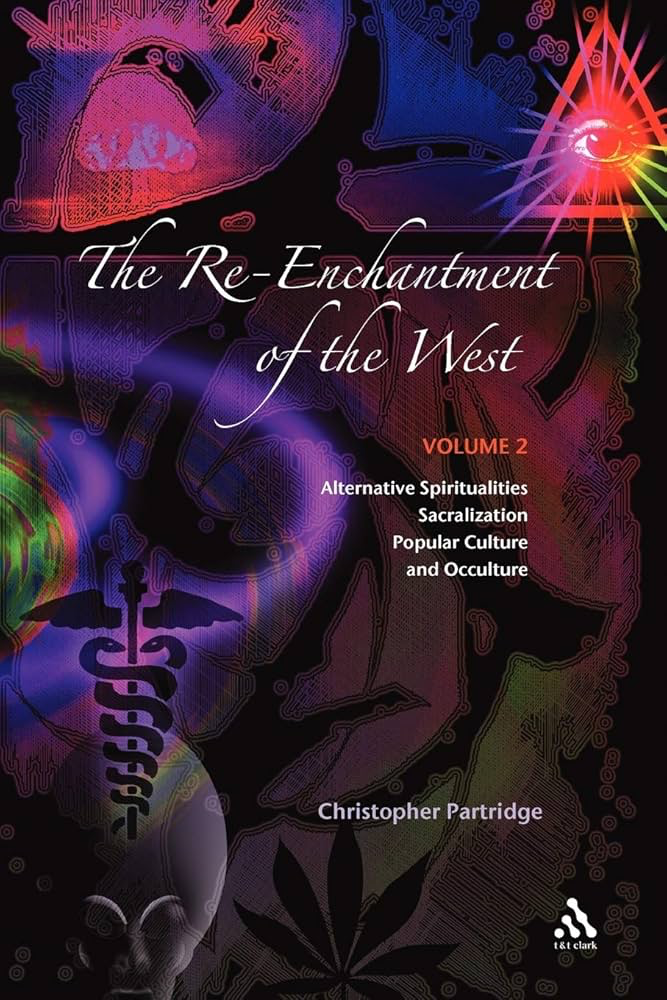
Christopher Partridge is a leading scholar in the field of religious studies and popular culture, known for his analysis of spirituality in modern Western society. His 2005 book The Re-Enchantment of the West: Alternative Spiritualities, Sacralization, Popular Culture, Vol. 2 elaborates on the theory of re-enchantment, a process by which the modern Western world, often seen as dominated by rationality, secularism, and disenchantment, is experiencing a renewed sense of wonder, meaning, and spiritual significance. This re-enchantment, Partridge argues, is driven by the search for meaning and spiritual experience outside institutional religion.
In the chapter “Dark Occulture: Contemporary Western Demonology,” Partridge explores how ideas of the demonic, the occult, and the supernatural have evolved within Western popular culture. He argues that the modern West is undergoing a process of “re-enchantment,” where spiritual and magical ideas are re-emerging through media, music, and entertainment.
The term “dark occulture” describes the growing fascination with what is considered forbidden or sinister spirituality, a cultural shift that indicates not a decline of religion, but its transformation within secular contexts. Partridge traces this fascination with the demonic to Christianity’s long history of defining evil. The Christian notion of Satan as the embodiment of rebellion and temptation continues to influence Western narratives about darkness, even in secular media. He contrasts this with other religious traditions, such as Hinduism, which perceive good and evil as intertwined forces rather than moral opposites. By highlighting these distinctions, Partridge shows how Western dualism has shaped both fear and attraction toward the occult.
The chapter also considers how “dark spirituality” manifests in subcultures such as heavy metal music, horror films, and modern witchcraft. Partridge argues that popular culture allows audiences to explore moral boundaries. He identifies the increasing visibility of Satanic imagery and occult symbols as signs of cultural re-enchantment rather than moral decay. Furthermore, Partridge argues that modern “occulture” functions as a form of alternative knowledge, challenging established religious and scientific authority. This “spiritualisation” of culture, expressed through fascination with demons, vampires, and the supernatural, reflects society’s continued search for meaning in a disenchanted age. “Dark occulture” reveals the persistence of myth and spirituality in everyday life, demonstrating the shift of the West’s relationship with evil from condemnation to curiosity.
Criticism
While Partridge’s chapter offers an engaging analysis of Western demonology, several aspects of his arguments have been debated and require further context. He references Michel Foucault’s Madness and Civilisation when discussing how Western culture has historically defined and marginalised the “irrational.” However, Partridge mainly uses Foucault to support his claim that Western modernity represses enchantment, while Foucault’s original argument was more complex. Foucault did not argue for a loss of enchantment but for a redefined process, where “madness” was recategorized as something to be studied, diagnosed, or excluded from normal life. Foucault would not necessarily support Partridge’s narrative of “re-enchantment” but rather describe contemporary interest in the occult as a revaluation of what society allows as “reasonable.” This interpretation challenges Partridge’s binary between a disenchanted secular culture and a newly enchanted popular one.
Similarly, Partridge’s broader thesis of the “re-enchantment of the West” has been criticised by scholars such as Egil Asprem, who argues that the West was never fully disenchanted to begin with. Asprem explains that enchantment persisted in scientific and psychological discourses even during the rise of secular modernity. Therefore, Partridge’s “re-enchantment” may not represent a return of spirituality, but a continuation of the existing human need for meaning and mystery through contemporary culture. This challenges the linear structure implied in Partridge’s work, suggesting that “dark occulture” is not a rediscovery of lost belief but an ongoing coexistence between scientific and occult thinking.
Another criticism of Partridge’s work is his lack of concern for the social and economic context of his analysis. While he identifies “dark occulture” as evidence of a renewed spiritual curiosity, Adam Possamai argues that much of this contemporary spirituality is “hyper-real”, a form of religion produced and consumed through popular culture rather than through traditional belief systems. Possamai’s theory of “hyper-real religion” implies that the rise of occult imagery in music, film, and fashion might be better understood as postmodern, commodified spirituality shaped by consumer choice rather than as genuine cultural re-enchantment. This contrasts with Partridge’s optimistic view and suggests that the popularity of the occult might reflect commercialized postmodern culture more than a genuine spiritual transformation.
Lastly, Partridge assumes a relatively uniform Western audience for occult media, but this view can be nuanced through Hill’s research on paranormal media audiences. Hill shows that viewers approach paranormal content with varying degrees of belief and scepticism, often engaging with it as entertainment rather than spiritual exploration. This complicates Partridge’s claim that popular culture indicates a collective re-enchantment, suggesting instead that engagement with “dark occulture” is highly individualised.
In conclusion, Partridge’s “Dark Occulture: Contemporary Western Demonology” provides a valuable framework for understanding the apparent resurgence of the paranormal in popular culture. Nonetheless, his work relies on a strict binary between the occult and the secular, overestimates the novelty of contemporary re-enchantment, and generalises audiences rather than grounding his claims in empirical evidence.
One of the things I’ve deeply reflected on this module, once again, is how human our desperation and need for meaning truly are. We constantly look for something, even if it’s irrational, to explain who we are and why we exist. When science can’t satisfy this need, we turn to unorthodox ways of understanding the world. But really, it’s impossible for humans to ever fully know the meaning of life, even if almost everything we do is driven by that same curiosity, or maybe insecurity, of the intrinsic meaning of existence.
REFERENCES:
- Asprem, E. (2014) The Problem of Disenchantment: Scientific Naturalism and Esoteric Discourse, 1900–1939. Leiden: Brill.
- Foucault, M. (1961) Madness and Civilisation. Paris: Plon.
- Hill, A. (2011) Ordinary and Extraordinary: An Ethnographic Study of Paranormal Media Audiences. London: Routledge.
- Partridge, C. (2005) ‘Dark Occulture: Contemporary Western Demonology,’ in The Re-Enchantment of the West: Alternative Spiritualities, Sacralization, Popular Culture, Vol. 2. London: T&T Clark, pp. 208–254.
- Possamai, A. (2012) Religion and Popular Culture: A Hyper-Real Testament. New York: Routledge.
 BISILA