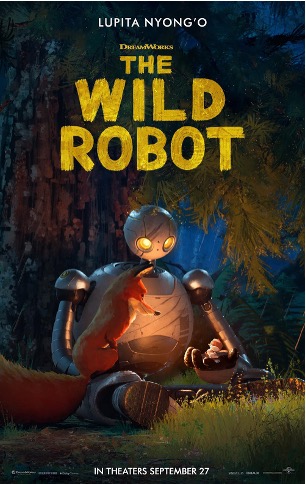
I went to see The Wild Robot (2024) partly because I love going to the theatre and partly because I knew I was going to cry. And I did. Hard. By the thirty-third minute, the whole audience was sniffling along with me, and by the end, I had a headache from all the emotions, and it was absolutely worth it.
The Wild Robot (2024) is a film adaptation of Peter Brown’s 2016 book of the same name. The mise-en-scène is set in a futuristic America, and it follows Roz, a robot who ends up stranded on an uninhabited island. Designed as a problem solver, Roz explains, “Simply give me a task and I will complete it.” After waking from the crash, she immediately begins solving problems for the island’s wild animals, unintentionally earning a reputation as a destructive monster. During a confrontation with a fox, Roz accidentally kills an entire family of goslings, though one egg survives. Roz dedicates herself to raising the gosling, teaching it the essentials for survival: eating, swimming, and flying.
The film explores four central sci-fi themes: environmental destruction, life creation, artificial intelligence, and dystopia. Like many works in the genre, it employs emotional anthropomorphism. As Jaques (2014) explains, children’s literature allows for a post-humanistic approach, enabling philosophical discussions while remaining accessible and engaging. Roz serves as a lens through which we can examine found family, self-accomplishment, and empathy.
Indurkhya, Indurkhya, and Venture (2024) discuss the concept of empathetic robots. Following in the tradition of Frankenstein, The Wild Robot portrays the journey of a human-made creation toward self-consciousness. Roz fits the archetype of the caregiver robot or AI replacement parent, similar to Kazuo Ishiguro’s Klara and the Sun (2021) or Becky Chambers’ A Closed and Common Orbit (2016). Unlike those examples, Roz is not bound to servitude; the film emphasizes her autonomy and search for purpose after achieving sentience.
The humans in the story aren’t exactly the heroes. They send a robotic army to reclaim Roz, burning the island’s natural habitat in the process. Later, we see robots working in an enclosed floating food farm. These scenes raise questions about environmentalism and position humans as antagonists, similar to Blade Runner (1982), where humans use robots to enforce control and punish those who defy societal norms. While the film’s ecocritical themes are not explored in depth, this omission is understandable given its target audience of children.
But what really hit me was the emotional core of the story. The Wild Robot is about maternity and the struggles of raising a child, it asks the audience what motherhood really means, what makes one sentient, the psychological distress of being adopted, the importance of community and collective support, the destruction and torture of nature caused by humans, and the fear of being different and the dread of wanting to be part of something or important for someone while simultaneously fearing and not understanding intimacy.
Resources:
- Indurkhya, X., Indurkhya, B., & Venture, G. (2024). The Value of Specific, Expansive Imaginary Scenarios: an Exploration of Recent Science Fiction Literature Through the Lens of Robotics. In 2024 21st International Conference on Ubiquitous Robots (UR) (pp. 525-531). IEEE.
- Jaques, Z. (2014). Children’s Literature and the Posthuman: Animal, Environment, Cyborg (1st ed.). Routledge. https://doi.org/10.4324/9780203581490
 BISILA