
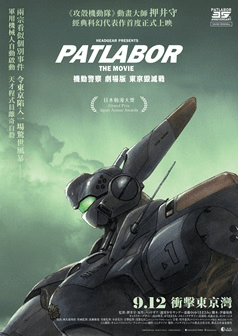
If you’ve ever wondered why Japan loves robots so much, Patlabor the Movie is a good place to start. Watching futuristic police officers team up with massive crime-fighting robots, I have to admit, I was mostly bored throughout the film. Still, the movie is part of a long tradition of Japanese fascination with robots, from Tik-Tok in L. Frank Baum’s 1907 Ozma of Oz to Astro Boy on 1960s TV screens. Japan has built a cultural love for robots that blends technology, philosophy, and human emotion, and Patlabor carries that tradition forward, showing robots not as villains but as tools, partners, and mirrors of human choices. In this review, I’ll explore how the film uses its futuristic setting, complex characters, and robot-centric plot to reflect on humanity, responsibility, and our uneasy relationship with technology. To say it quickly, A CLASSIC:
Tik-Tok, the mechanical character from L. Frank Baum’s 1907 book Ozma of Oz, is often cited as one of the very first robots in literature (Science Museum, 2018). In Japan, the fascination with robots has grown into a full-blown genre: mecha, a category of science fiction that explores futuristic robotic existence. Patlabor the Movie fits squarely into this genre.
This re-screening of Mamoru Oshii’s 1989 film, part of the Patlabor franchise created by the manga group Headgear, follows two police officers in a futuristic Tokyo. They team up to stop a computer virus threatening the city’s crime-fighting robots. While the film centers on these officers, secondary characters unexpectedly rise to prominence, becoming key players or heroines in the story.
To fully appreciate the film, it helps to understand the history of Japanese science fiction. In 1900, Oshikawa Shunro published The Undersea Warship (Kaitei Gunkan), which sold out and earned him the title of Japanese science fiction’s grandfather. However, the organized emergence of Japanese SF is often traced to the 1950s. Publishers such as Gengensha, Kodansha, and Hayakawa translated and released SF series; in 1957 Shibano Takumi created the fanzine Uchūjin (Cosmic Dust), and in 1960 Fukushima Masami launched SF Magazine. The 1960s also saw the foundation of the Science Fiction and Fantasy Writers of Japan (SFWJ) and the rise of critical essays by first-generation writers like Abe Kōbō and Komatsu Sakyō (Taillandier, 2021). On a global scale, Japanese SF introduced kaijū eiga, beginning with Gojira (Godzilla) in 1954, and this fascination with monsters went hand in hand with a love of robots, particularly in manga and anime. Tezuka Osamu’s Tetsuwan Atomu (Astro Boy), which aired in 1963 in both Japan and the US, was the first of many friendly Japanese robots, contrasting with the dehumanizing robots common in Western science fiction (Bolton, Csicsery-Ronay, & Tatsumi, 2007).
In terms of the film’s message, Bolton (2007) suggests that Patlabor is concerned with “the fear that these robotic tools will rise up without pilots and rampage en masse… a progressive alienation from our original bodies, threatening dehumanization.” While this is a valid reading, the film presents a more positive view. Two dialogues illustrate this: “As long as we don’t mess with the machines, the machines won’t mess with us,” and “We can’t let Labour be the bad guys.” Unlike many other robot narratives, Patlabor portrays robots as tools serving humans, not independent threats.
The film continues the creation narrative popularized by Frankenstein (Mary Shelley, 1818), but with a twist: the robots are not antagonists. The danger comes from humans using them improperly. This aligns with the portrayal of robots in Astro Boy, where they are helpers rather than threats. A similar mecha story with apocalyptic undertones is Neon Genesis Evangelion (1996), but unlike Evangelion, Patlabor emphasizes that robots cannot act independently; their actions are always linked to human guidance.
One potential critique of the film is its pacing. It can feel uneven, with moments of dense information followed by quieter gaps. This likely stems from condensing a long-running series into a two-hour movie. While the film delivers the key story beats, some narrative threads feel rushed or incomplete, a challenge common to cinematic adaptations of serialised works.
Resources:
- Bolton, C., Istvan Csicsery-Ronay, J., & Tatsumi, T. (2007). Robot Ghosts and Wired Dreams: Japanese Science Fiction from Origins to Anime. Minneapolis: University of Minnesota Press. https://muse.jhu.edu/book/27673.
- Science museum (2018). FRIEND OR FOE? ROBOTS IN POPULAR CULTURE. Available at: https://www.sciencemuseum.org.uk/ (Accessed 01/10/2024)
- Taillandier, D. (2021). Literary Science Fiction in Japan: The Story of a Secret Infiltration. Mechademia 14(1), 167-184. Project MUSE, https://muse.jhu.edu/article/805964.
 BISILA