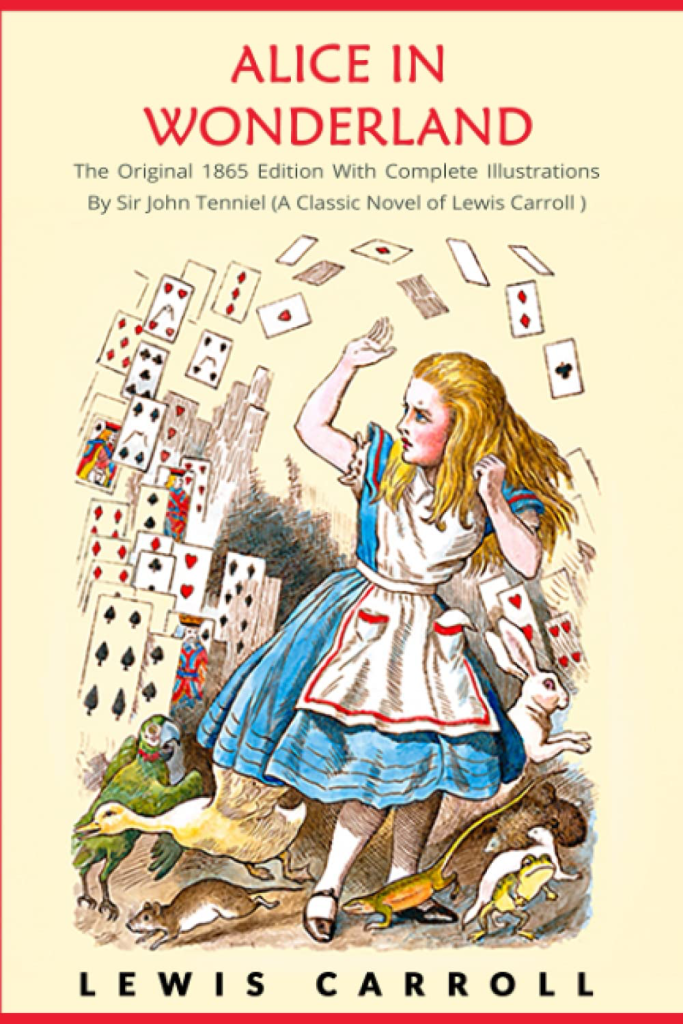
Alice was my first great love in fiction. Alice in Wonderland was both my favorite Disney film and one of my favorite books, until Spirited Away unseated it in 2008. What I loved then, and still love now, is that Wonderland isn’t simply whimsical; it’s strange in ways that linger, unsettling in ways that feel alive. Alice taught me early on that stories could bend the rules of sense and still feel true.
So, instead of writing one oversized rabbit hole of a post, I thought I’d do something different: three little adventures into Alice. Think of it as a mini-series, each post a new door to open.
Here’s where we’re going:
- Alice – revisiting the story itself and the magic that makes it timeless.
- Alice in Pop Culture – where Alice shows up when she sneaks out of Wonderland.
- Alice in Fashion – how the tea parties, playing cards, and curious aesthetics spilled into style.
Dreams, Illogic, and Identity in Alice’s Adventures in Wonderland
Lewis Carroll’s Alice’s Adventures in Wonderland (1865) is often remembered for its strange characters, talking animals, and playful nonsense; nonetheless, it is a story about dreaming. This essay looks at how dreams and illogical thinking shape the story’s events and characters, and why these elements are more than just entertaining, they are meaningful. It will also explore how the dreamlike nature of Wonderland has made it such a lasting part of global culture. From modern music videos to Japanese street fashion, Alice’s surreal world continues to inspire artists, designers, and storytellers. By looking closely at these examples, we can see why the story still resonates today, more than 150 years after it was written.
The Importance of Dreams and Fantastical Illogic
Carroll’s novel is a landmark of literary nonsense and fantastical fiction, famously framed as a dream. Alice’s journey uses the dream structure to explore the fluidity of identity, challenge Victorian rationalism, and critique the adult world. Its dreamlike illogic has since become a cultural touchstone, embraced for its imaginative freedom and its capacity to mirror human consciousness.
The story opens with Alice “beginning to get very tired of sitting by her sister on the bank,” before she spots a White Rabbit and follows it down a rabbit-hole (Carroll, 1865, p. 1). This plunge marks the beginning of her dream journey. From the outset, time and space in Wonderland obey no earthly logic; she falls “down, down, down” for what feels like an eternity, yet lands unharmed, already signaling the suspension of reality (Carroll, p. 3). The dream framework justifies the story’s loose structure. When Alice grows and shrinks repeatedly, later summarized in pop culture as “one pill makes you larger, and one pill makes you small”, she experiences the dreamlike sensation of bodily distortion. In one scene, she laments, “I’m never sure what I’m going to be, from one minute to another” (Carroll, 1865, p. 25). As Bulkeley (2019) notes, these abrupt transitions, strange metamorphoses, and illogical sequences mirror patterns observed in actual dream research (p. 50). This instability captures both the mutability of identity in dreams and a child’s confusion during emotional and physical growth.
Illogic as Resistance
The illogic of Wonderland often works by overturning the rationality of the human world. Characters take figures of speech literally, forcing Alice, and readers, to navigate strange linguistic norms. For instance, during her conversation with the Duchess, Alice is told that “mustard isn’t a bird,” to which the Duchess replies, “If everybody minded their own business… the world would go round a deal faster than it does” (Carroll, 1865, p. 52). These exchanges mimic the way dreams distort meaning, often compressing metaphors and misunderstandings into vivid, confusing scenes.
MacArthur (2004) notes that Carroll’s linguistic games often require Alice to solve problems creatively, despite the absence of any real solution (p. 54). The Mad Hatter’s riddle “Why is a raven like a writing desk?” famously has no answer (Carroll, 1865, p. 57). Yet the lack of resolution still provokes curiosity.
Alice repeatedly questions her identity, a key theme of the story. After growing uncontrollably and crying a literal pool of tears, she wonders, “Who in the world am I? Ah, that’s the great puzzle!” (Carroll, 1865, p. 19). This crisis reflects not only dream logic, where the self often shifts form, but also childhood anxieties about growing up.
Her encounters with Wonderland’s authority figures further highlight the dream’s subversive power. The Queen of Hearts, for example, is a tyrannical figure who constantly screams, “Off with their heads!” yet never actually executes anyone (Carroll, 1865, p. 68). The threat is more absurd than frightening, exposing the irrationality of authoritarianism both in dreams and, metaphorically, in Victorian society. Bulkeley (2019) suggests that Carroll used dream logic to parody such structures of control, enabling young readers to recognize their absurdity without overt rebellion (p. 53). Similarly, Auerbach (1973) argues that Alice’s curiosity and moral independence position her as a radical child who resists social conditioning through the dream’s protective ambiguity (p. 35).
The climactic trial scene reinforces this theme. When Alice declares, “You’re nothing but a pack of cards!” (Carroll, 1865, p. 89), she exposes the Queen’s authority as hollow. This moment is crucial, signaling Alice’s growing awareness and her refusal to submit to irrational power — much like a dreamer awakening from a nightmare.
Alice’s Cultural Legacy
The fantastical illogic and dream structure of Alice’s Adventures in Wonderland have also fueled its enormous cultural legacy. Thomas (1988) argues that Carroll transformed dreams into a profitable literary commodity, anticipating how Freud would later analyze and market dreams as psychological texts (p. 38). Wonderland’s dreamscape appeals across cultures because it offers liberation from rules and roles. In a world increasingly governed by logic, science, and productivity, Alice continues to give readers of all ages a space for playful rebellion and introspection.
Its illogic is not meant to be solved but experienced, as a metaphor for the unpredictability of the human mind. This adaptability explains why the story has been endlessly reimagined in films, operas, art, and consumer products. Its characters, from the Cheshire Cat to the Mad Hatter, have entered the cultural lexicon as symbols of absurdity and playful resistance.
CLICK:
 BISILA