
“A class system is based on both social factors and individual achievement” (Griffiths et al., 2014).
But what happens when individual achievement is limited by a person’s social position, and when their very identity becomes a double marginalisation?
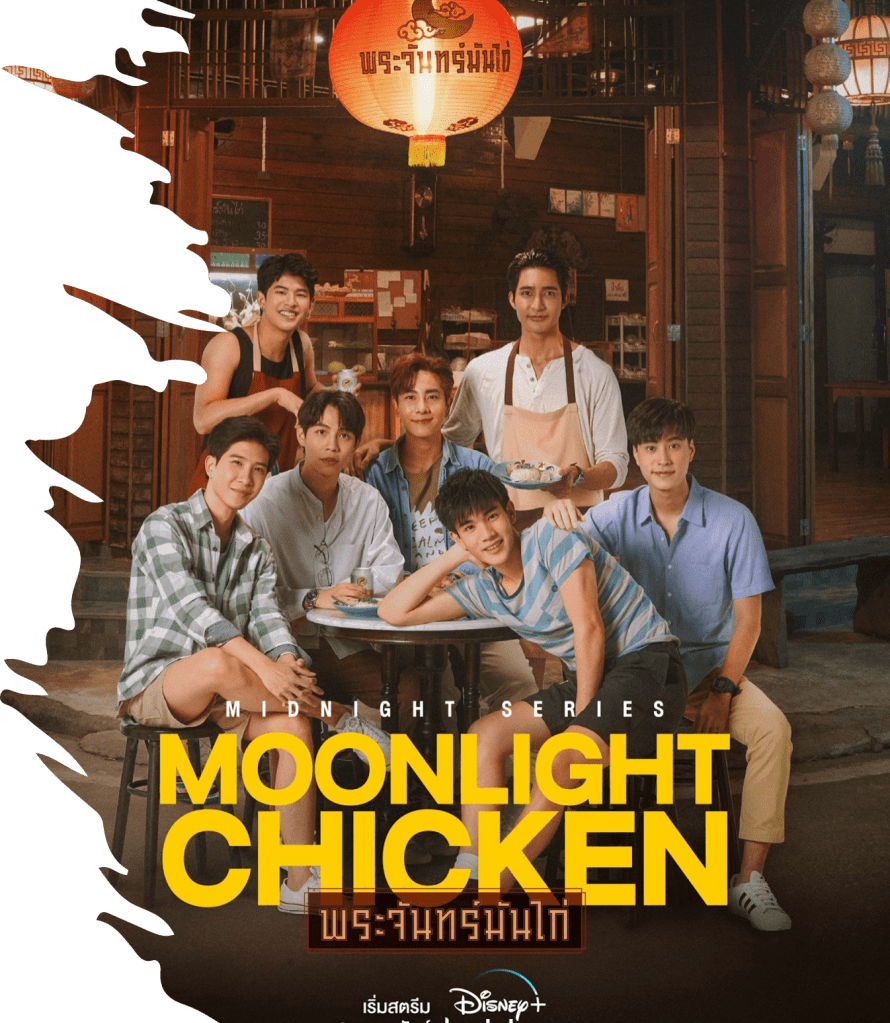
In this post, I’ll analyse the intersection of class and queerness in the 2023 Thai series Moonlight Chicken. This isn’t just a show about romantic entanglements, it’s a drama that navigates poverty, sexual identity, social mobility, and the layered pressures of cultural respectability. Through the lens of four queer characters and their varying class positions, the series paints a picture of love constrained not only by sexuality but also by money.
Introducing the World of Moonlight Chicken
Set in Pattaya, Thailand, the show centers on “Uncle” Jim, a working-class man in his late thirties who runs a humble chicken rice restaurant. He lives with Li Ming, his teenage nephew, who was abandoned by his mother and raised by Jim. The story deepens as Jim begins a romantic relationship with Wen, a middle-class, educated gay man in his twenties. Meanwhile, Li Ming falls for Heart, a deaf queer teenager. There’s also Gaipa, a wealthy, soft-spoken friend of Jim who clearly harbours feelings for him.
The show relies on character-driven storytelling and leans into progressive realism, although some moments tip into melodrama, with “exaggerated and excessive style” (Mercer & Shingler, 2013). Still, at its core, the series is about the emotional and structural consequences of queerness and class in Thai society.
Class: The Weight of Poverty
From the first episode, class is established as a central theme. The story opens with a non-diegetic voiceover that turns out to be from a TV interview about the instability of restaurant businesses during the COVID-19 pandemic. Poverty is foregrounded as the driving tension.
One stark example is when Heart blames Li Ming for an accident. Heart’s parents, particularly his father, a police officer, take his side without question. Heart manipulates their perception of him as a pitiful disabled child to shift blame onto a working-class boy. The implication is clear: class determines whose version of truth is believed.
Li Ming and Jim clash frequently, especially over education. Jim sees schooling as their only path to social mobility. He pushes hard, believing that escaping poverty means academic success, even if it creates emotional distance with his nephew. As Creeber (2009) notes, social realism in film often “constructs working-class life as a problem, one in need of a solution” (p. 428), and in Moonlight Chicken, that solution is positioned narrowly as education.
Queerness in a Masculine Frame
Despite being gay himself, Uncle Jim avoids discussing sexuality with Li Ming, repeatedly telling him to “leave it for adults” (Noppharnach, 2023). Jim is conflicted, he wants a better life for his nephew and sees queerness as an additional burden on top of poverty. His internalized homophobia reflects a generational tension and the stigma still attached to queerness in conservative societies.
There’s also a clear issue of selective queer representation. The four actors playing the main romances all conform to ideals of masculinity, both in character and in their public personas. The only character who presents in a more feminine way is Gaipa, and the show handles him with less care. In episode two, another character jokes that Gaipa shouldn’t meet Wen in case he falls in love “too.” This trope of the “promiscuous, sassy gay man” undercuts Gaipa’s character and reinforces harmful stereotypes about femininity within queerness.
Intersectionality: Who Gets to Be Queer in Public?
Thailand still does not recognize same-sex marriage. Within this context, the show reflects “Kala-thetsa,” a Thai term that refers to awareness of social hierarchy and the expectation to behave according to your rank (Wijngaarden, 2021). Respectability politics loom large.
For queer characters like Wen, Heart, and Gaipa, economic privilege shields them from some of the consequences of being out. Wen is middle class, Heart’s family has resources, and Gaipa benefits from inherited wealth. Their love lives, while not problem-free, are portrayed as relatively protected.
Li Ming and Jim, by contrast, exist at the bottom of the hierarchy. In episode seven, a brutal scene between uncle and nephew distills this tension when Jim cries out:
“Isn’t it difficult enough to be born poor? And now you are gay?” (Noppharnach, 2023).
Here, queerness becomes an added burden, not because of inherent shame, but because of the vulnerability it creates for the already marginalized.
McRuer (2016) argues that queerness in popular media must be “embodied by figures that ‘can be tolerated’” (p. 396), usually meaning those who are economically or socially successful. This framing makes queerness acceptable only when it is aspirational. Moonlight Chicken touches this idea, showing how those with class privilege can safely love, while those without must choose between survival and authenticity.
A Missed Opportunity for Structural Critique
While the show raises important issues, it stumbles when it comes to representation and political critique. Women are portrayed with glaring essentialism: one scene includes a joke about a woman being on her period when she asks for food; in others, she is painted as irrational or greedy. At a group dinner, the only woman present is expected to serve the food. Li Ming’s absent mother is another trope, the neglectful, selfish woman. Misogyny isn’t just a heterosexual problem, and Moonlight Chicken reminds us that queerness doesn’t automatically mean feminist.
The series also avoids deeper political inquiry. It places the burden of poverty on individual circumstances, a missing parent, a failed relationship, rather than on systemic issues. The family’s ethnic Chinese identity is hinted at but never explored, missing an opportunity to discuss how ethnicity shapes class and respectability in Thai society. Even the looming demolition of Jim’s restaurant, a clear case of gentrification, is treated as inevitable rather than unjust.
In trying to make social issues palatable to mainstream audiences, Moonlight Chicken risks turning real struggles into emotional spectacle. It markets itself as progressive realism but often stops short of real critique, offering viewers a glimpse into queerness, disability, and poverty, but keeping them safely on the outside looking in.
P.S.
Just to add to my ongoing issues with Moonlight Chicken‘s portrayal of queerness and class, we also need to talk about its representation of disability. Heart, a character who is said to have been deaf for only 2–3 years, is inexplicably portrayed as completely non-verbal throughout most of the show. When he does finally speak, it’s as if he’s been deaf since birth, lacking speech patterns or vocal imitation entirely. This isn’t just a minor detail; it’s a clear example of disability being used as a plot device without even the most basic research.
A quick five-minute Google search would tell you that a teenager who becomes deaf later in life would still retain fluent speech, even if isolated. The show’s writers clearly didn’t even bother. Disability is reduced here to aesthetic and emotional leverage, a storytelling device rather than a lived experience. It’s not just a plot hole; it’s a failure of care, of imagination, and of representation.
REFERENCE:
- Creeber, G. (2009). ‘The truth is out there! Not!’: Shameless and the moral structures of contemporary social realism, in New Review of Film and Television Studies, 7(4), 421-439. Available at: https://doi.org/10.1080/17400300903306995 (Accessed 15/02/2024).
- Griffiths, H., et al. (2014). Introduction to Sociology-1st. Canadian edition. BC Campus: Victoria, BC, Canada.
- McRuer, R. (2010). Compulsory able-bodiedness and queer/disabled existence, in The disability studies reader, 3, 383-392. (5th ed.). New York & London: Routledge.
- Mercer, J., & Shingler, M. (2013). Melodrama: Genre, style and sensibility. New York: Columbia University Press.
- Moonlight Chicken (2023) GMMTV. Available at: YouTube (Accessed: 10/02/2024).
- van Wijngaarden, J. W. D. L. (2021). Male Homosexuality in 21st-Century Thailand. London: Anthem Press.
 BISILA