
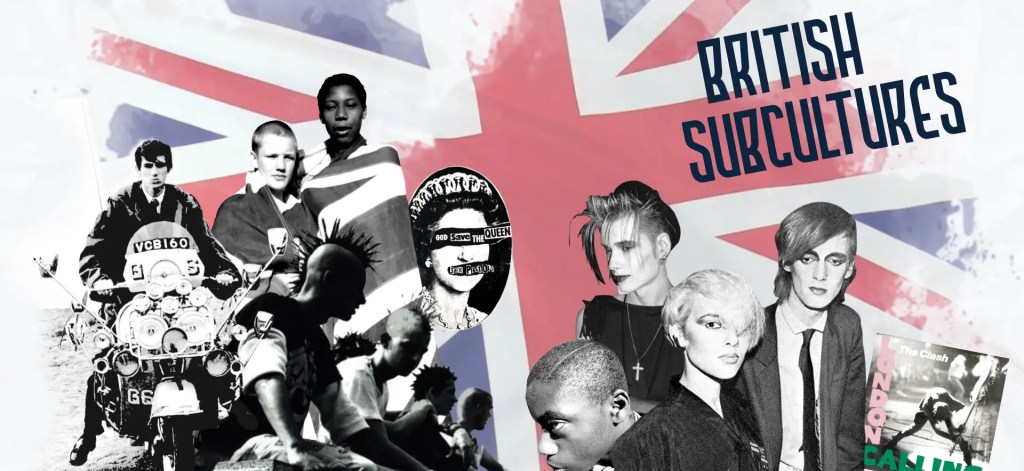
Hebdige’s 1979 book Subculture: The Meaning of Style discusses subcultures in British post–World War Two as forms of resistance and offers an analysis of said subcultures. In this essay, I will be discussing chapter five of this book: “The Function of Subculture.” I will divide the content into two sections: the analytical part and the critical part. The analytical part will consist of a summary of the content discussed in the chapter, and the critical section will be a discussion of five critics of Hebdige’s work.
Hebdige explores in this chapter the relationship between subcultures and cultures, and how subcultures are defined by their deviance from culture. After the Second World War, the way in which class was experienced in terms of culture drastically changed. The working class was polarized, and generational consciousness became vivid amongst young people. Youth culture was a consequence of this polarization.
There is a critique of the mainstream understanding of youth culture as classless, and how historical context was not seen as part of the discussion. Hebdige discusses different methods of subcultural studies such as Frederick Thrasher’s participant observation method in 1927, Albert Cohen and Walter’s 1950s theoretical perspective, or Matza and Sykes (1961) and their “subterranean values” notion. Citing Gramsci’s concept of hegemony, style in subculture is created as a symbolic form of resistance; in this case, resistance to the postwar period. Studying the notion of style in subculture, he divides it in two: specificity and the sources of style.
Hebdige uses Hall’s 1976 definition of culture as “giving expressive form to social and material experiences,” to explain how said material is always mediated and never raw. That is why specificity or conjuncture are indispensable to the study of subculture, since subculture is a response to a set of circumstances; and the same response, but a different circumstance, will create a new outcome or different “mediated material.” He gives the example of the Teddy Boys and how the first and second wave were received drastically differently. This is due to the relationship of the subculture with the dominant and parent culture: the society perceiving the second wave was full of nostalgia for the 50s, while the first wave was seen as a disruption of society.
This goes back to the point of lack of historical context in studies of subculture, and why it matters. In terms of sources of style, he discusses how media and social experiences (family, school, friends…) are the main sources in forming the material of culture. Citing Hall, he argues that media has colonized the cultural and ideological sphere and often falls into dramatization of reality, mostly developing a moral panic. It also discusses how class can be overlooked, overstated, denied, or reduced in its representation in media. Hebdige lastly discusses how subcultures are defined by their effort to achieve otherness. Taking the punk culture and Bowie-ites, both were similar in the way they used material to symbolically challenge the dominant culture; in other words, the use of style to signify subculture.
Criticism
- Misleading Chapter Title
The first criticism of Hebdige’s work would be the title of the chapter, “The Function of Subculture,” as it could be misleading. Hebdige does discuss the function of subculture in the book; however, this chapter would be better described as a study of style and the relationship of subculture and culture, instead of a study on the function of subculture. - Use of Past Tense / Lack of Cultural Longevity
Reading from the perspective of a 2024 state of subculture, this chapter is characterised by the usage of past tense when discussing subcultures such as punk, which is the next criticism of this work. As Dale (2020) noted, Hebdige studied subculture as a past event and not an ongoing cultural aspect. He could not have forcibly known how subcultures would evolve; however, due to the importance of subculture in 2024, it is needed to criticize the lack of understanding of the longevity of subculture. - Class Exclusivity
Webb (2020) also criticised the division of class in this study and how subculture, from the perspective of Hebdige, only comes from the working class, omitting the middle class in the discussion. - Omission of Music
Another important omission in his work is music. Hebdige focused on style in terms of visual codes; however, he missed the importance of musical style and uniqueness among subcultures. As Pitre (2003) discussed, music possesses cultural and semiotic importance; however, the study of subculture in the 20th century was defined by the lack of music study. - Lack of Diversity and Intersectionality
The final criticism is the absence of diversity in his studies. It is important to note that this chapter has mention of the Bowie-ites; nonetheless, the overall study focused on white male subculture, excluding proper research on female, LGBTQIA+, or other ethnic groups. At the start of this chapter, Hebdige writes: “The subcultures introduced in the previous sections have been described as a series of mediated responses to the presence in Britain of a sizeable black community.” Despite this affirmation, his study of subculture is focused on the white working class. As Pitre (2003) discusses: “his work lacks any comparable analysis of the blacks and West Indians to which these subcultures and styles are a response […], it is as though he is perpetuating a colonial mentality that continues to dismiss ‘ideological currents once easily dismissed as distant illusions belonging to foreign lands and peoples’” (Bilby, 211). This is of important matter to his discussion of parent and dominant culture studies, since he did not study the possible parent cultures of punk that derived from ethnic cultures. It also denies the existence of intersectionality in subcultures; ethnic cultures and the British subcultures were divided, as if people of other ethnicities could not be part of the subcultures discussed.
To conclude, Hebdige’s Subculture: The Meaning of Style is still a relevant book for the study of subcultures, and this chapter illustrates the importance of specificity and class. Nonetheless, time has proved a lack of depth or understanding in some areas of this research, such as race, intersectionality, music, or cultural longevity.
PS. Giving grace to Hebdige, the inclusion of minorities and intersection in the 70´s was not a normal occurrence in academia, so maybe I am being too harsh.
REFERENCING:
- Dale, P. (2020). ‘The Scholar and the Punk: Hebdige’s Master Narrative and the Deceptive Self-Knowledge of the Subaltern.’ In Hebdige and Subculture in the Twenty-First Century, pp 71–89. Available from:https://link.springer.com/book/10.1007/978-3-030-28475-6 [Accessed: 04/01/2024]
- Hebdige, D. (1979). ‘The meaning of style’ in The function of subculture. (pp. 73-89). London: Routledge. https://doi.org/10.4324/9780203139943
- Webb, P. (2020). ‘Resuscitating the Subcultural Corpse: A Reflection on Subculture as Lived Experience and the Importance of Class and Ethnicity!’ In Hebdige and Subculture in the Twenty-First Century, pp 51–69. Available from: https://doi.org/10.1007/978-3-030-28475-6_4 [Accessed: 04/01/2024]
- Pitre S. (2003). ‘Cultural Studies and Hebdige’s Subculture: The Meaning of Style’ in Tendances dans l’étude de la musique populaire. 07/12/03. Available from: https://tagg.org/students/Montreal/Tendances/PitreHebdige.html [Accessed: 04/01/2024]
 BISILA